________________________________________________________________________________________________________________
No. 657 DECEMBER 2025 Eds. Don Cooper / Bill Bass
On behalf of the HADAS Chair and Committee, we would like to take this opportunity to wish all our readers a Merry Christmas and Healthy, Happy and Prosperous 2026.
HADAS DIARY – Forthcoming lectures and Events
HADAS Festive Celebration will take place at Avenue House on Sunday 18th January 2.30-5.30pm. £20 per head with quiz and buffet. The cost is £20 pp as last year. The booking forms have already been sent out and we are asked for them to be returned by the end of November in order to establish numbers. However, if members . guests are still deciding we can have some flexibility here and extend the deadline to around mid-December. Payment to the Treasurer as per the forms.
Tuesday February 10th 2026. Dr James Bromwich. “Great archaeological discoveries and great archaeologists of France: Alexandre du Mège: a founder of archaeological research in France – or rogue? Léon Joulin: an outstanding intellect and a founder of modern archaeology. Émile Chénon: a leading nineteenth century lawyer with a love for archaeology. Sophie Krausz: in the forefront of twenty-first century archaeology and museum presentation”
Tuesday March 10th, 2026. Les Capon from AOC Archaeology is back after his last very interesting lecture this time he will talk about archaeological material evidence from Bricks to Gold.
Tuesday April 14th, 2026. Scott Harrison on “Behind the Battle of Barnet banners. People of the War of the Roses. The lives of people that fought at the Battle of Barnet and the life society and culture of the late fifteenth century.”
Lectures are held in the Drawing Room, Avenue House, 17 East End Road, Finchley N3 3QE. 7.45 for 8pm. Buses 13, 125, 143, 326, 382, and 460 pass close by, and it is a five-ten-minute walk from Finchley Central Station on the Barnet Branch of the Northern Line where the Super Loop SL10 express bus from North Finchley to Harrow also stops.
Tea/Coffee/biscuits available for purchase after each talk.
1
A note from Susan Loveday on the proposed HADAS TRIP TO DERBY IN APRIL
We have looked into resuming a trip for the group. Reserved Date 23rd April 2026. – 3 nights to Derby area, Dinner, Bed and Breakfast. This area is one of considerable natural resources that brought settlers there through a long period of time. We’ll hear about discoveries and how the area became a centre of innovations. We would get a group rate on the hotel, but coach price reflects numbers.
To stop at Coventry on way, once a wealthy medieval town. Hear more and visit Cathedral and its story via a talk. Propose to include visit to a Cave, Plague Village and its interesting Museum, with new information, Mills and other stops. Centre of Railways, a ride on heritage railway. Updated price I have been given is £589 sharing and £685 for single occupancy. Numbers reflect coach price. Entry fees included. If viable, deposits would be collected during January.
HADAS members visit to Tudor Hall in Barnet on 23rd October 2025 Don Cooper
This visit had been arranged by Mike Noronha, the Curator of Barnet Museum and Sandra Claggett our chairman. We assembled at Barnet Museum at 16.00 on a damp cold evening and had time to explore this fascinating museum. Once all had arrived, we walked to Tudor Hall.
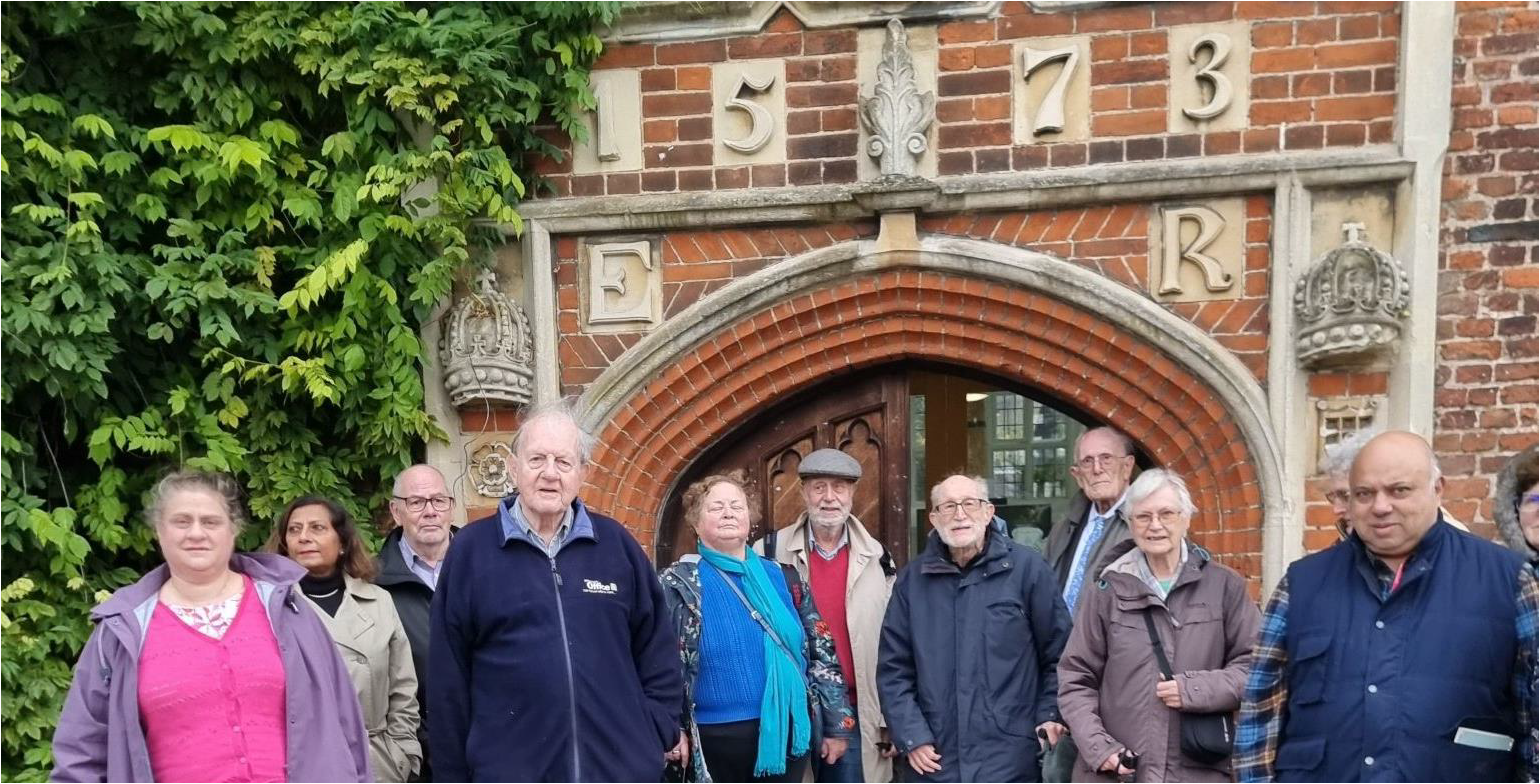
The history of this Grade II listed building (List entry 1286564) goes back a long way as witnessed by the date over the entrance. The 1573 date refers to the granting of a charter by Queen Elizabeth the first on a petition of Robert Dudley, the Earl of Leicester. The charter allowed for creating of a Free Grammar School. The charter describes its role as:
“Bringing up and instruction of boys and youth, to be brought up in grammar and other learning, and the same to continue for ever, and the said School for one Master and one Usher for ever to continue and remain and that there shall be for ever four-and-twenty discreet, honest governors.”
However, the present building was not erected until 1577 funded by collections from London Churches and the first governors of the school.
2
Throughout the next two and a half centuries the school continued to expand and prosper. For example, a masters house was added, dormitories for pupils built and ancillary buildings added. By 1932 the Queen Elizabeth school had outgrown the building, and it moved to its present site in Queens Road, Barnet where it has continued to prosper.
The Tudor Hall building was then bought by the Jesus Hospital charity for £1750 and was used by them as offices and for their meetings. The rest of the site was bought by Hertfordshire County Council for £3000. South Herts. College moved on to the site in 1948, and the college was built on land surrounding the hall. Jesus Hospital Charity sold the hall to Hertfordshire County Council to be used for educational purposes.
In 1965 Barnet Council assumed responsibility for the whole site and embarked on a large expansion including demolition the Masters House, other classrooms and ancillary building around the hall.
In 1968 the Hall was remodelled by Barnet Council at a cost of £30,000 and became part of Barnet and Southgate college. The Hall continued to be used as classroom.
In 2024 the College decided that the hall was surplus to their requirements, and the college have put the hall up for sale. The target price is £1m.
A number of local societies (Barnet Museum among others) have looked at purchasing the property, but it has no land around it and is an isolated building in the midst of Barnet and Southgate College and would need refurbishing to the upper floor.
Estimated running are expected to around £50k a year.
At the time of HADAS visit the hall was empty but was occasionally used for classes, conferences etc. The upper floor is not in use.
Description of inside of the hall.
On entry the is an entrance lobby with toilet facilities. The main hall (see photo below) is currently laid out has a classroom. It is well lit and heated. The only reminders of its history surviving are the Inglenook fireplace with its shield and the so called “Whipping Post”. There is a mezzanine gallery overlooking this hall. From the mezzanine gallery there is a staircase leading to the 1st floor and it also goes down to a fire exit.
There is another staircase at the far end of the building that serves the same purpose
In their current state the staircases are not suitable for regular access.
3
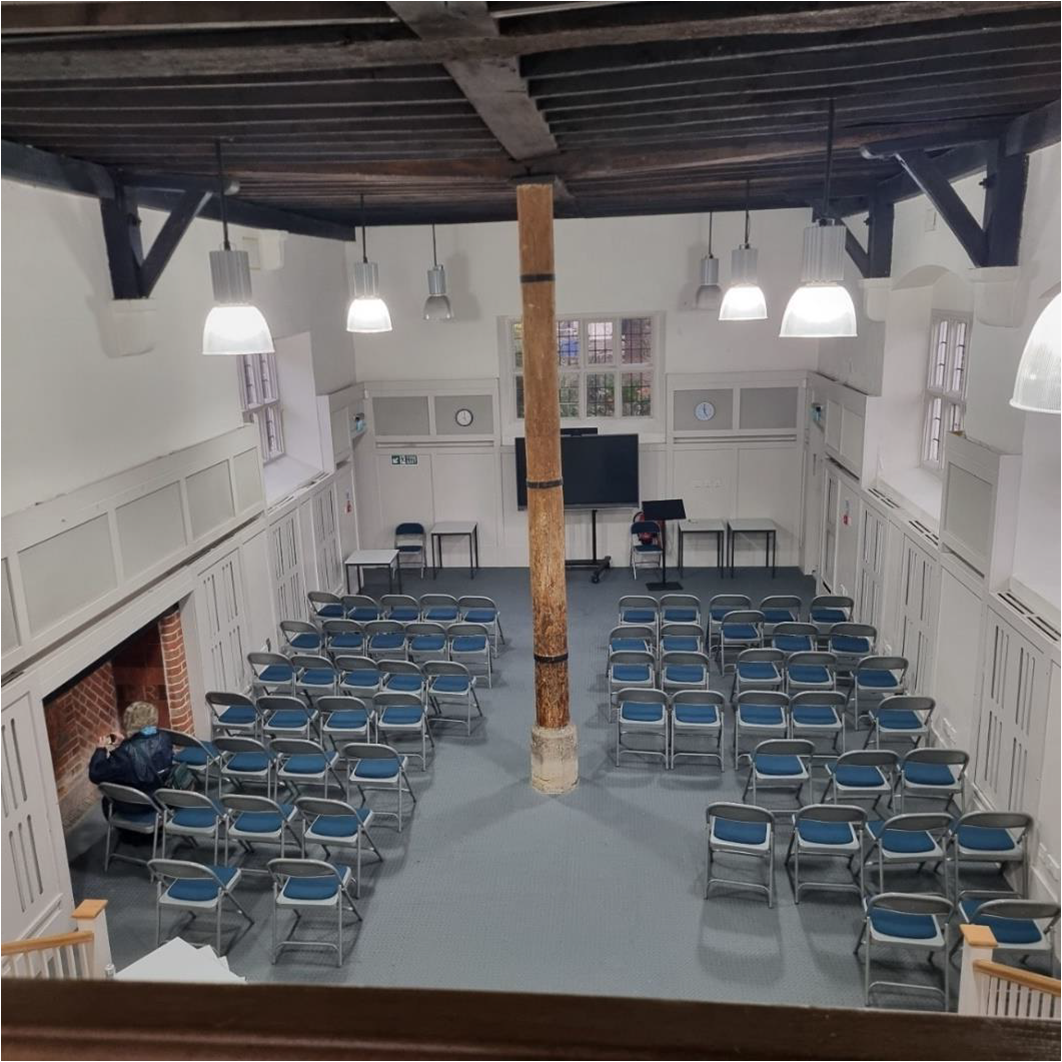
Figure 1 Main Hall
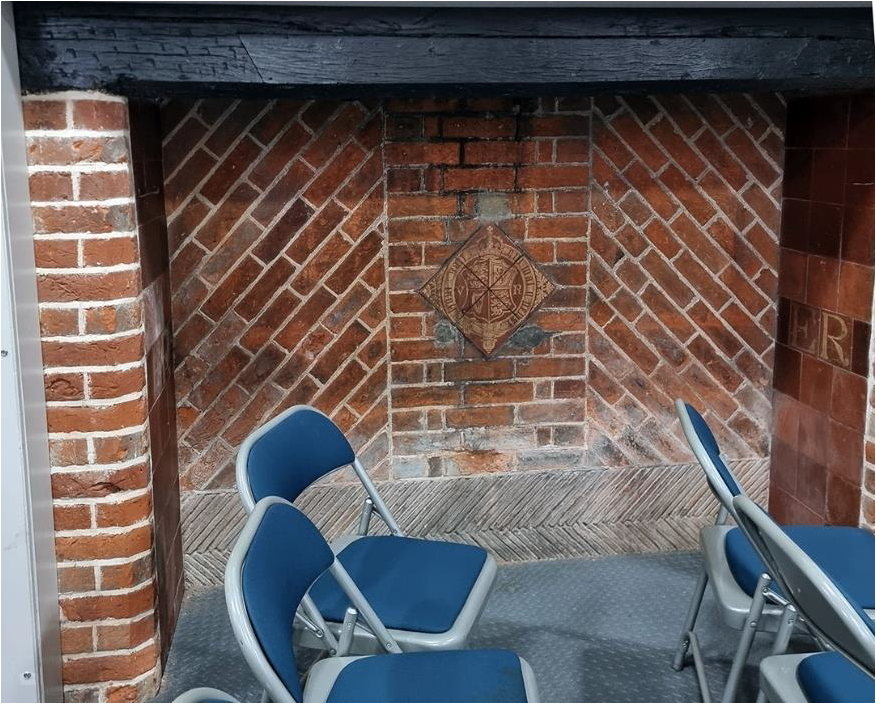
Figure 2 Fireplace in the hall
4
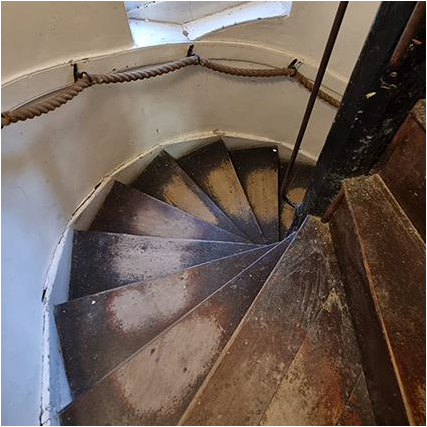
Figure 3 Spiral staircase
The rooms on the upper floor need some TLC.
Summary
The Elizabethan Tudor Hall is the last remaining building standing of what had been an extensive complex of structures including the Masters House, classrooms, dormitories, kitchen, laundry and laboratory etc. supporting a successful school.
It would be a great shame if this iconic building was lost to community use.
Thanks are due to Mike and Sandra for making this interesting visit possible.
5
Below are three photos showing the upper floor area:
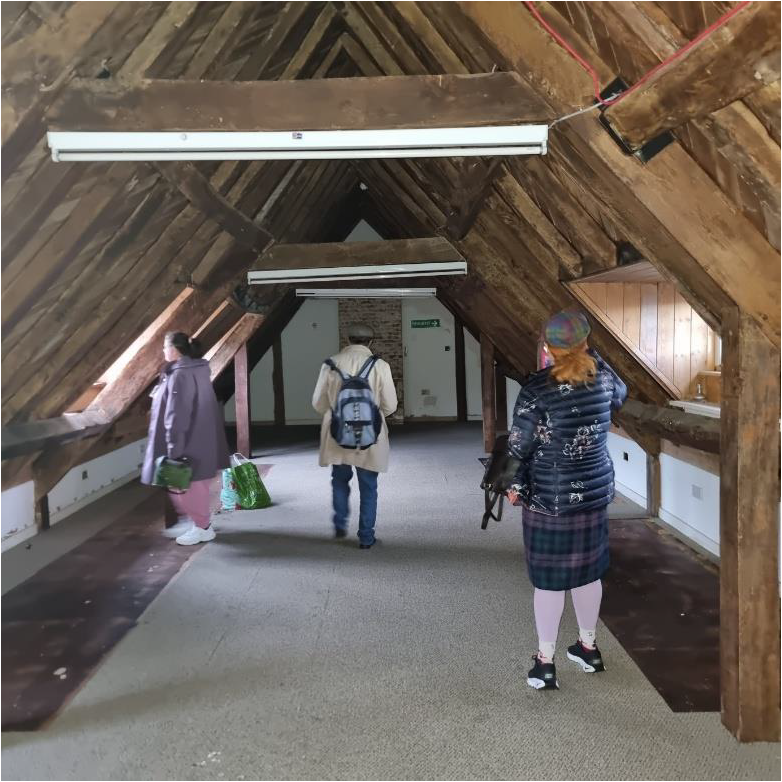
Figure 4 Upper floor area
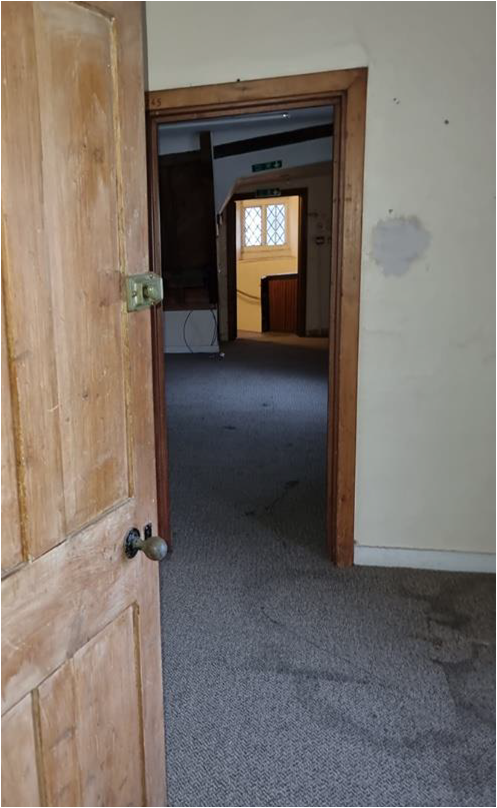
Figure 5 View to offices spaces
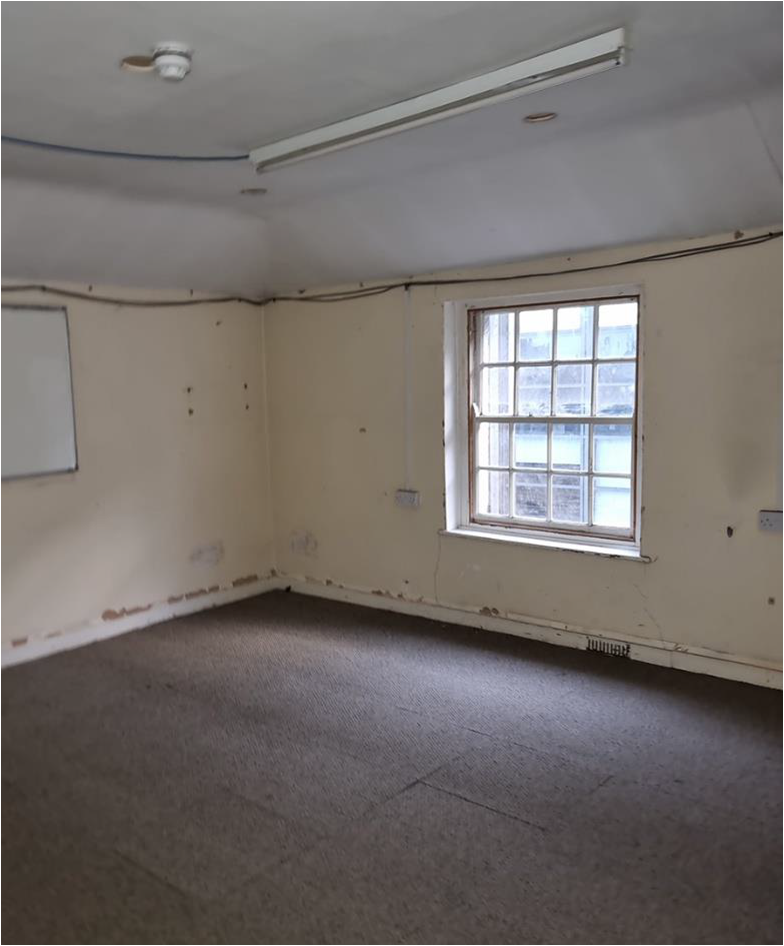
Figure 5 Large office space
6
HADAS bus pass outing to London Docklands Museum
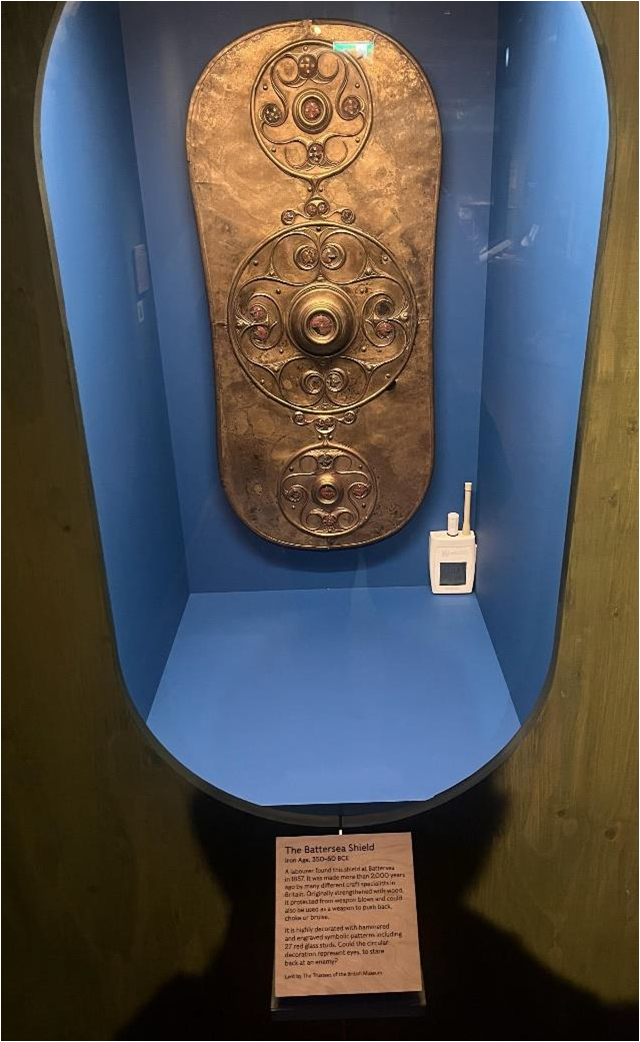
At the beginning of November we had a HADAS “bus pass” outing to the Secrets of the Thames exhibition at the London Museum in Docklands.
The exhibition set out information on the history of mudlarking and had a fine collection of finds, ranging from tiny pins and Roman intaglios to the Battersea Shield.
All who attended enjoyed the exhibition very much, as well as the adjournment to the pub next door for lunch afterwards.
CVA24 Church Road – Pottery Report – Trench 2 and Trench 3. Melvyn Dresner
Please see newsletters August and September 2025 for previous Church Road dig finds articles.
Trench 2
Trench 2 included pottery in context 001, 006 and 007.
Context 001 (Topsoil)
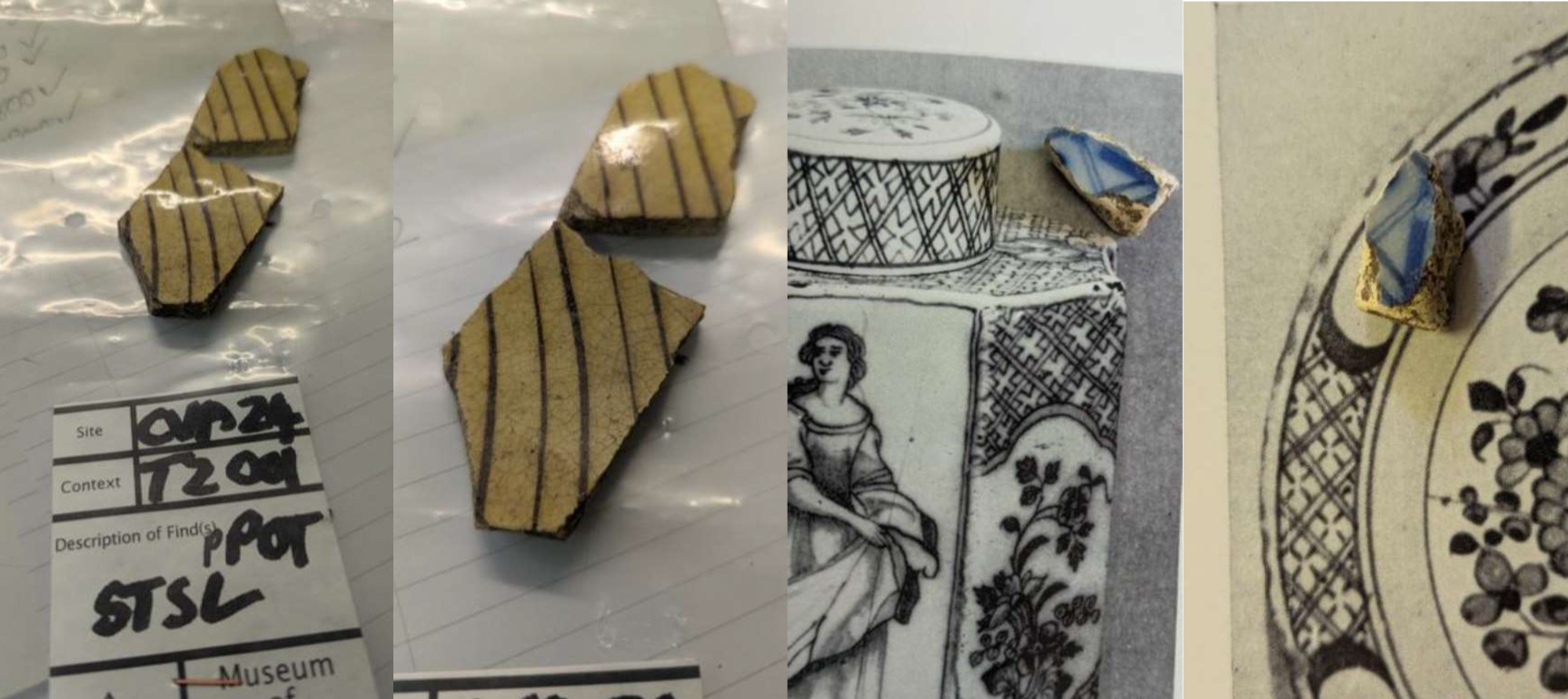
This context is dominated by 18th, 19th and 20th pottery refined white earthenware (REFW), post medieval redware (PMR), also English stoneware (ENGS), English porcelain (ENPO), transfer printed ware (TPW), one piece of tin glaze ware (TPW H) and two pieces of Staffordshire slipware (STSL).
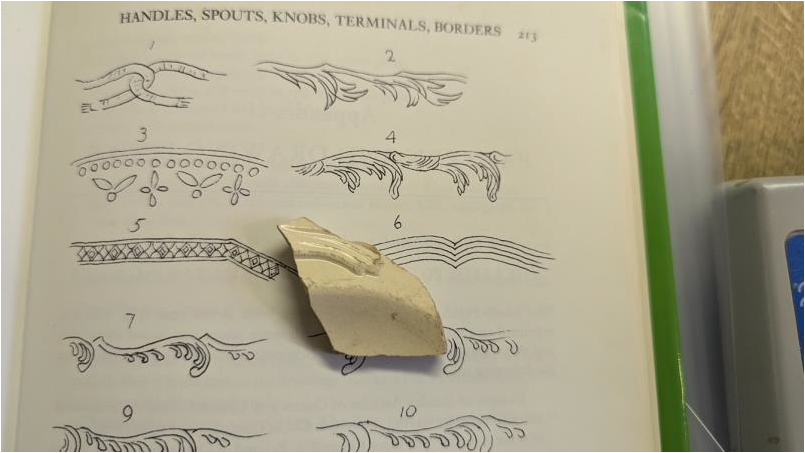
Image (below) shows Staffordshire slipware, and tin glaze ware with geometric design compared to reference examples
7
Of the REFW, over half of circa 200 sherds are burnt and too fragmented to represent identifiable vessels. This includes mainly plain ware and some decorated ware with blue and gold banding, green and brown glaze. Where identifiable, the sherds represent a typical domestic assemblage of cups, plates and bowls.
The second largest group (8 sherds) include transfer printed ware (TPW and TPW3) including blue and white, buff, yellow and orange decoration, and one with vine or grapes. 11 pieces of PMR include PMR Slip with brown glaze and white slip. There were three sherds of English porcelain (ENPO), blue and white with red scrolling on one piece. The twelve pieces of English stoneware included burnt pieces, bowls and jugs. Also, four pieces of cream ware (CREA) dating from late 18th century/ early 19th century, with applied decoration (compare to examples from Downer 1978, below) with the tin glaze wear and Staffordshire slipware, probably represent 18th century occupation of the site.
This context also includes a possible saltshaker in the form of a porcelain mouse.
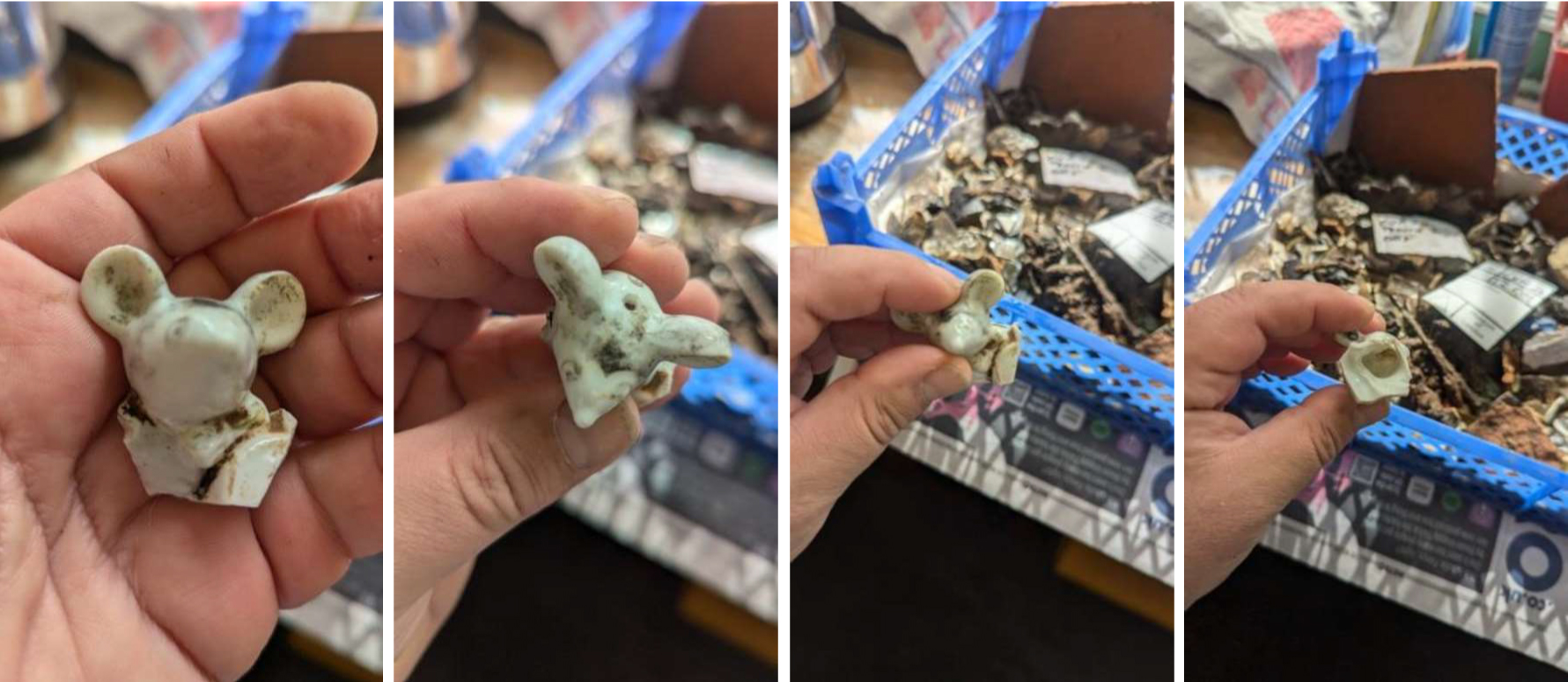
8
Creamware from Donald Towner’s Creamware (1978, Faber and Faber)
Context 006
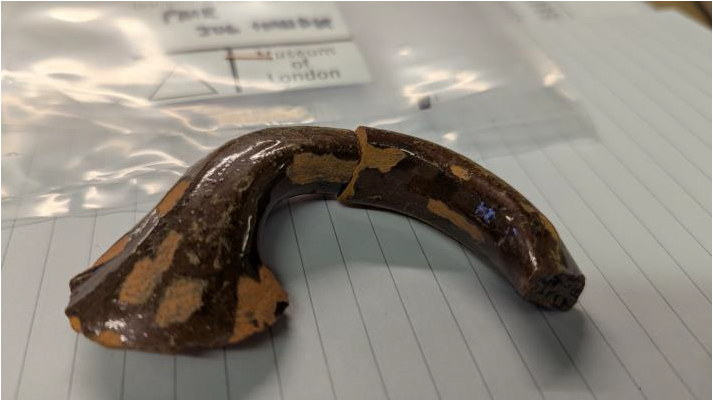
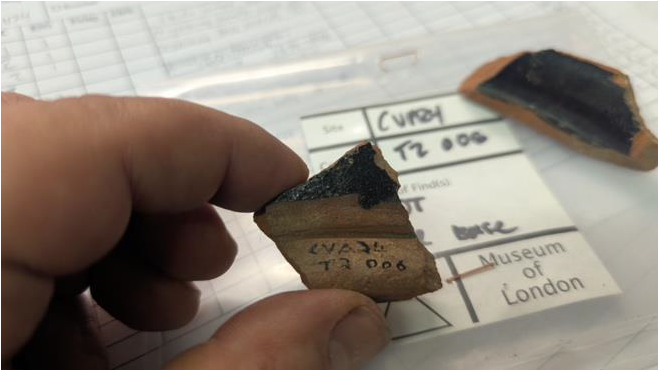
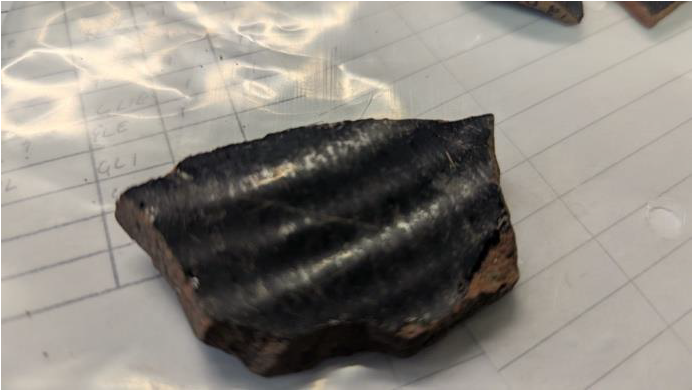
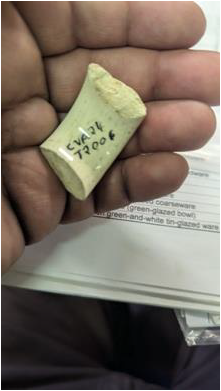
This pottery assemblage is mainly 19th and 20th century, with traces of 18th century pottery. This context includes post medieval redware (PMR) and refined white earthen ware (REFW), as well as post medieval black glazed redware (PMBL), English stoneware and Staffordshire slipware, sewer pipe and piece of tin glaze ware (TGW Blue).
Handle (T2, context 006)
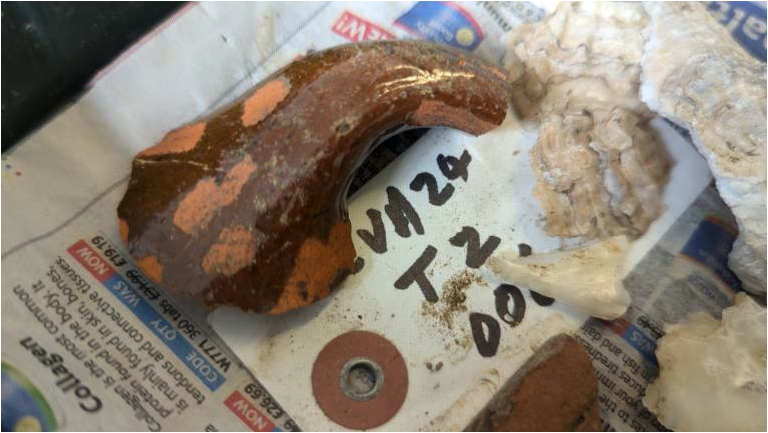
Handle (T2, context 006)
9
PMR, stoneware and PMBL
Context 007
Seven pieces of post medieval redware (PMR) – base and body sherd- and one piece of stoneware handle.
Trench 3
Context 001
This represents 19th and 20th century occupation of the site. Sixteen pieces of refined white earthen (REFW), three pieces of English stoneware, two sherds of tin glaze ware (TPW), and five sherds of post medieval redware.
Context 005
Complete stoneware (ENGS) ink bottle or boot black, 3 ½ inches tall (circa 89mm)
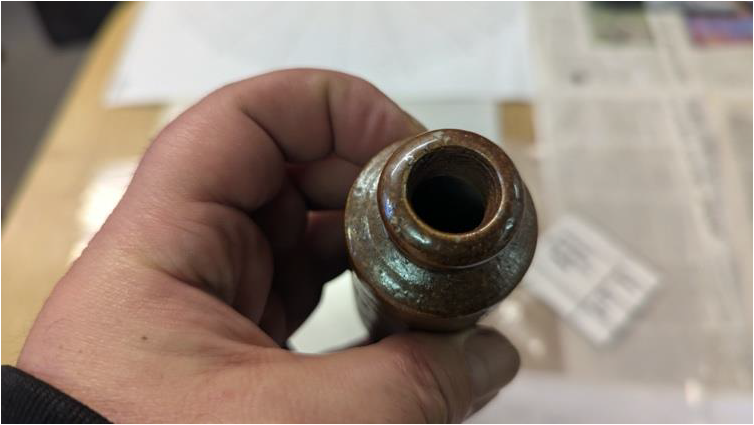
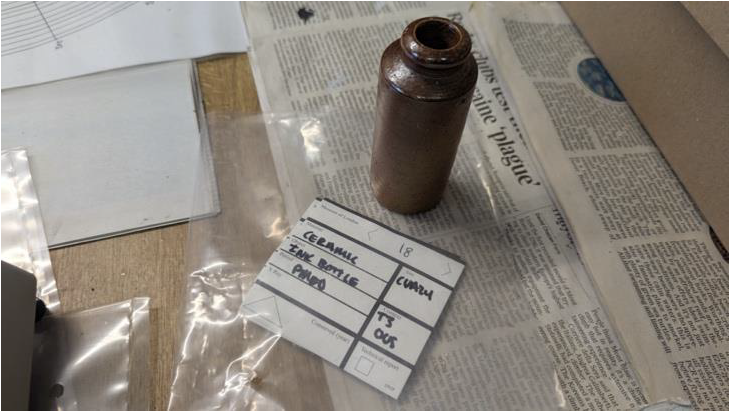
This ink bottle alongside the slate pencil found on site (trench 1. Context 001), may link to the school on site.
10
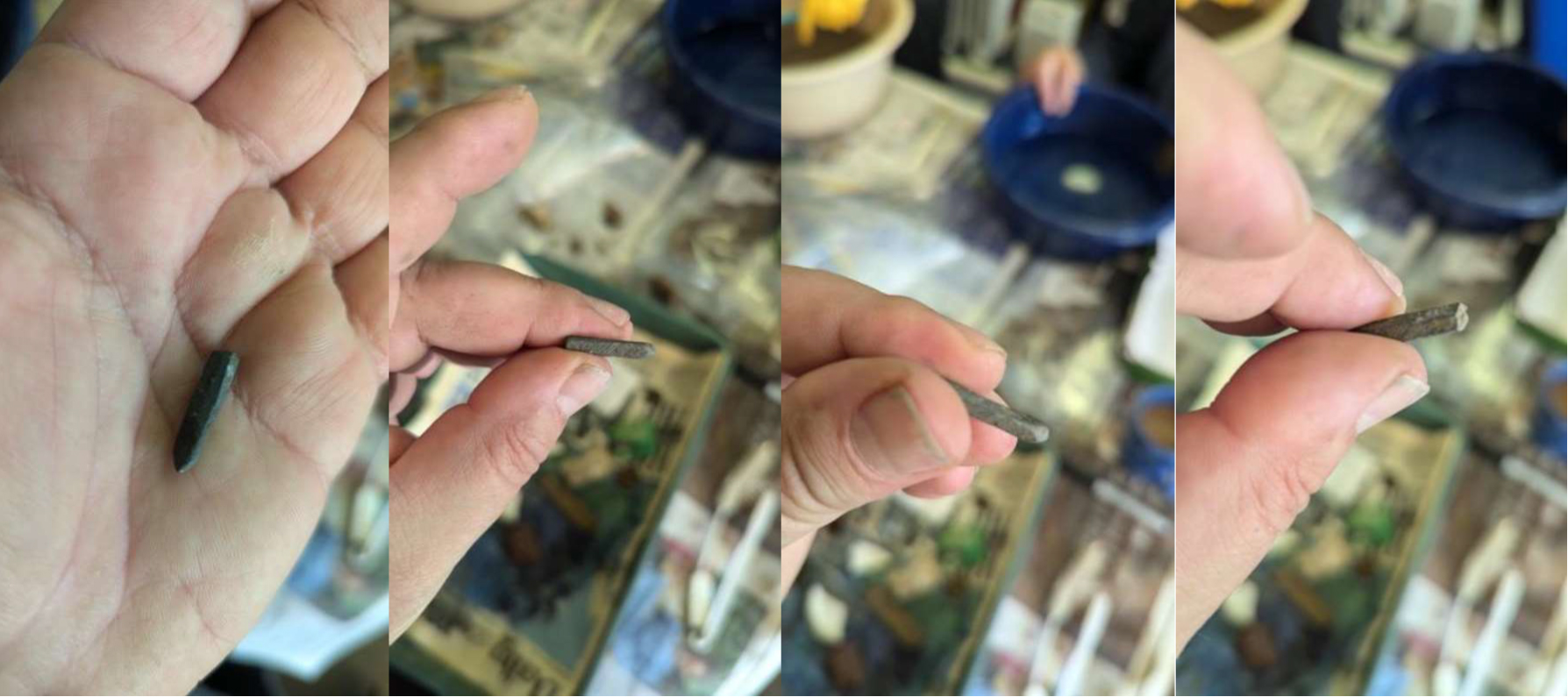
Examples in museum collections at the National Trust Museum of Childhood: https://www.nationaltrustimages.org.uk/image/1265085.
Portable Antiquities Scheme: https://finds.org.uk/database/artefacts/record/id/476756/recordtype/artefacts.
OTHER SOCIETIES’ EVENTS Eric Morgan
As always, please check with the Societies’ website before planning to attend, since not all Societies or organisations have returned to Pre-Covid conditions.
Tuesday 13th January, 6.30 pm. L.A.M.A.S. Talk on Zoom. Digging Up the Future – 23 years of the Central London Young Archaeologists Club. By Karen Thomas and Annie De Saulles (Central London Y.A.C). Please visit www.lamas.org.uk for further details and link.
Tuesday 13th January, 8 pm. Amateur Geological Society. Talk on Zoom. Dinosaurs: New Visions of a Lost World by Professor Michael J. Benton. Please visit www.amgeosoc.wordpress.com for further details and link.
Tuesday 13th January, 8 pm. Historical Association (North London Branch), Jubilee Hall, 2, Parsonage Lane / Junction Chase Side, Enfield, EN2 0AJ. Nicholas II and Stalin – A Comparison in Tyranny? Talk by Dr. George Gilbert. Non-members £2, payable at the door.
Wednesday 14th January, 2.30 pm. Mill Hill Historical Society. Trinity Church, 100, The Broadway, London NW7 3TB. Tales of a Mill Hill Amateur Clock Maker. Talk by Martin Bourn. Please visit www.millhill-hs.org.uk.
11
Thursday 15th January, 8 pm. Historical Association: Hampstead and N.W. London Branch. Fellowship House, 136A, Willifield Way, London NW11 6YD (off Finchley Road, Temple Fortune). The Fourth Crusade. Talk by Professor Jonathan Harris. In the year 1204, Constantinople was attacked, captured and pillaged by an army composed of Christian co-religionists who were supposedly on a crusade to recover Jerusalem.
The talk explores how that strange contradiction came about, what the consequences were and how the events still resonate today. Also on Zoom. Please email Dudley Miles (HADAS) on dudleyramiles@googlemail.com or telephone 07469 754075 for details of link and how to pay (there may be a voluntary charge of £5). Refreshments to be available.
Friday 16th January, 7.30 pm. Wembley History Society. St. Andrew’s Church Hall (behind St. Andrew’s new church) Church Lane, Kingsbury, London, NW9 8RZ. Remembering the General Strike 1926-2026. Talk by Christine Coates. Visitors £3. Refreshments available in the interval.
Tuesday 27th January, 7.30 pm. Hounslow and District History Society. Talk on Zoom. Thames Islands by Nick Pollard. Non-members charge £2. For log-in please contact James Marshall at ajmarshall@gmail.com.
Thursday 29th January, 7.30 pm. Finchley Society. Drawing Room, Avenue (Stephens’) House, 17 East End Road, London, N3 3QE. The White Lady…Another fascinating talk about Espionage in WWII by Helen Fry about the British Secret Service networks in Belgium behind Enemy lines in the First and Second World Wars. For further details please visit www.finchleysociety.org.uk. Non-members charge £2. Refreshments to be available in the interval.
With thanks to this month’s contributors: Don Cooper, Melvyn Dresner, Sue Loveday, Eric Morgan
Hendon and District Archaeological Society
Chair: Sandra Claggett, c/o Avenue House, 17 East End Road, Finchley N3 3QE email : chairman@hadas.org.uk
Hon. Secretary: Janet Mortimer 34 Cloister Road, Childs Hill, London NW2 2NP (07449 978121), email: secretary@hadas.org.uk
Hon. Treasurer: Roger Chapman, 50 Summerlee Ave, London N2 9QP (07855 304488), email: treasurer@hadas.org.uk
Membership Sec: Vacant email: membership@hadas.org.uk
Website: www.hadas.org.uk
12