No. 658 January 2026 Edited by Peter Pickering
HADAS DIARY – Forthcoming lectures and Events
Lectures take place in the Avenue House Drawing Room.17 East End Road, Finchley N3 3QE, 7.45 for 8pm. Buses 13, 125, 143, 326 and 460 pass close by, and it is a five to ten-minute walk from Finchley Central Station on the Barnet Branch of the Northern Line. Bus 382 also passes close to Finchley Central 3QE, 7.45 for 8pm. Buses 13, 125, 143, 326 and 460 pass close by, and it is a five to ten-minute walk from Finchley Central Station on the Barnet Branch of the Northern Line. Bus
382 also passes close to Finchley Central Station. We are also on the SuperLoop Bus, Tea/Coffee/biscuits will be available for purchase after the talk.
Tuesday February 10th, 2026. Dr James Bromwich. “Great archaeological discoveries and great archaeologists of France: Alexandre du Mège: a founder of archaeological research in France – or rogue? Léon Joulin: an outstanding intellect and a founder of modern archaeology. Émile Chénon: a leading nineteenth century lawyer with a love for archaeology. Sophie Krausz: in the forefront of twenty-first century archaeology and museum presentation”
Tuesday March 10th, 2026. Les Capon from AOC Archaeology is back after his last very interesting lecture. This time he will talk about archaeological material evidence from Bricks to Gold.
Tuesday April 14th, 2026. Scott Harrison on “Behind the Battle of Barnet banners. People of the War of the Roses. The lives of people who fought at the Battle of Barnet and the life, society and culture of the late fifteenth century.”
PROPOSED HADAS TRIP 23 APRIL 2026 Sue Loveday
Step out of town for a while, group get together, see more and explore… the Peak District. Britain’s First National Park.
As mentioned in the previous Newsletter we are looking to resume a HADAS trip. 4 days, 3 nights, Bed, Breakfast and Evening meal staying in Derby. An area of various natural resources including lead, limestone, brought settlers over time. Its water powered the first Industrial revolution bringing roads, canals and railways. Visit to the Mills which brought change in production. Find out how the area also became a main place for the railways and have ride on heritage railway and later how it became a Centre of manufacturing, including even the red post box! A visit also to one of its caves – it has a few – and will also go to the Plague Village, site of an early lockdown and see its interesting museum with further information on the epidemics. Couple museum stops, church and other stops where settlers left their mark. Coventry Cathedrals on way there and intention to see Stoke on way back.
Price as per previous newsletter includes entrance fees. A Preferred number to make trip viable as can reflect coach price. Chance to see more together. Please email Sandra, Chair if interested. Deposits would be collected in January.
1
On 14 December a number of HADAS members had a most enjoyable Christmas Sunday lunch at
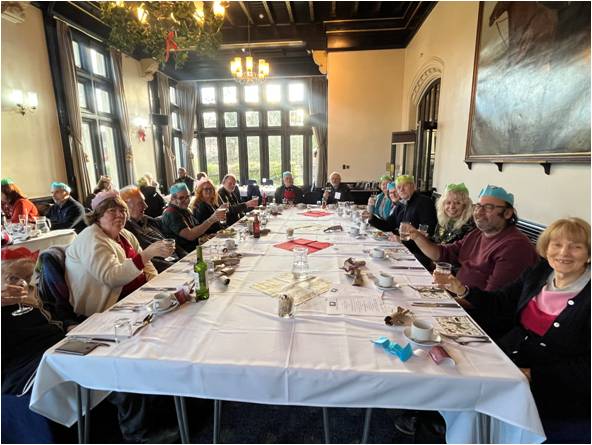
Avenue House, with all the seasonal trimmings. Thanks to Eric Morgan for organising.
Rutland Barbara Thomas
Rutland may be the smallest county in England but in 2022 it proved to be huge in respect of discoveries of the past. Not only were the remains of the largest ever ichthyosaur found at Rutland Water but a unique mosaic was uncovered in a village called Ketton. This is the story of the mosaic.
Ketton is the fourth largest area in Rutland for population with a count of some 2000 souls. It’s not a sleepy village by any means, being bisected by the busy A47 and is also home to a huge cement works and one of the largest solar farms in the UK at 9MW which supplies power to the works. It is also an area for farming.
The winter of 2019/2020 was very wet and farmers were struggling to grow crops in wet and sometimes flooded conditions. Ketton has the River Chater running through it and the river had risen over many fields.
The spring of 2020 brought drier weather – and the Covid lockdown. Jim Irvine, the son of a Ketton farmer, was visiting his family farm with his daughters in June of that year as there were few places available to visit in lockdown. They walked through a field on the banks of the Chater which had previously flooded, the girls picking up bits and pieces on the ground that they found interesting. These scraps included pottery shards and oyster shells which surprised Jim as he had ploughed this field many times before but had never seen such items. He reported the finds to Historic England and started investigating further.
Looking at the field on Google maps proved fruitless until he looked at the maps for 2018 which had been a particularly long hot summer. These maps showed crop marks which looked as if there was the outline of a building underground.
The family returned to the field and started to dig. Jim expected to find some sort of wall and dug an 8 ft trench. Instead of a wall, he found a floor made up of tiny tiles and as he cleared the soil away, there was a face.
2
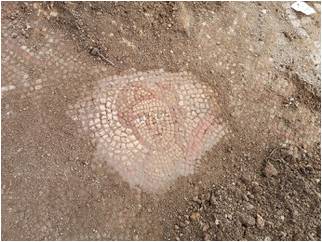
Photo : Jim Irvine
Realising there was something extraordinary under the ground Jim contacted the County Archaeologist who in turn brought in University of Leicester Archaeological Services. Further digging was done and geophysical analysis carried out.
The mosaic has been painstakingly drawn and detailed for record by David Neal, who has been a mosaic expert since the early seventies.
A more detailed dig under the auspices of Historic England was done in 2022. At this time the Digging for Britain programme was involved and the episode can still be found on iplayer (series 9 Episode 1).
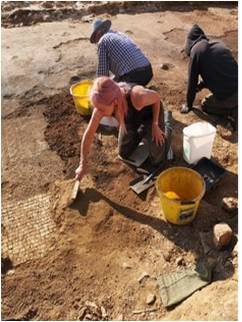
Prof Alice Roberts uncovering the mosaic
3
The mosaic is now covered up with sand and stones, and the land is able to be farmed again. If there is any further funding in the future, more work could be carried out. Only 10% of the site has been excavated to date.
What we know so far:
The mosaic covers an area 11m x 7m of a Roman villa dating from 2nd to the 4th century AD. It is the floor of an area probably used as a dining room or entertainment area and was designed to impress visitors to the villa. The mosaic depicts the story of the Trojan War and the battle between Hector and Achilles in a series of pictures reading from bottom to the top, but not quite in the way described by Homer in the Iliad. For example, where Homer describes the battle between the two being on foot, the villa owner has them on chariots.
The mosaic is part of a villa which is part of an estate covering about 5 hectares. For every villa there were about four wooden farmsteads. The estate was principally for the production of food but also a place for meetings and worship. After the Romans left the building had a more industrial use with evidence of burning, some of which has damaged the mosaic.
There is an aisled building on the estate which is built in a particular “British Roman” style. There is an east wing where work and productivity was carried out and a west wing for living quarters. This building also has a domestic bath suite with hypocaust, sauna and plunge pool. This building was later used for drying grain, principally sprouted spelt which was used for beer making.
Interestingly a lot of the building materials were found to be locally sourced. The roofing was either Collyweston slates or ceramic tiles made at a workshop near Corby. The marble came from Alwarton near Peterborough. Pottery came from the Nene Valley. 300 boxes of artefacts have been removed, containing some personal items such as jewellery, hairpins, brooches, buckles, gold rings; Styluses for writing; oyster shells and animal bones; and grinding stones which indicate that it was a mill at some point.
At the moment they have just come to the end of the assessment phase of the current project, next comes the analysis phase.
The subject matter of the mosaic is of great interest to scholars. An article appeared in the 2024 journal of the Association for the Study and Preservation of Roman Mosaics (ASPROM) and another is being published in ‘Britannia’ published by the Society for the Promotion of Roman Studies.
The Archaeology of Rapa Nui by Sandra Claggett
I recently had the opportunity to visit Easter Island or Rapa Nui for a few days to see the main archaeological sites led by a local guide. Rapa Nui is located in the southeastern Pacific Ocean; it is one of the most remote inhabited places on Earth. Despite its isolation, the island is world-renowned for its monumental stone statues known as moai.
This is an overview of the places I visited rather than a detailed guide.
We began with a visit to the quarry area Rano Raraku where the statues or Moai were cut out of the surrounding rock and the work started on the figures. The moai were carved between approximately 1250 and 1500 CE by the Rapa Nui people. The head size by itself is around a third of the total height with a large part of the statue buried below the surface. Some unfinished moai reach up to 20 meters in height and weigh over 150 tons, there are completed examples of average 4–10 meters tall. (Van Tilburg, 1994). We were observing the incomplete examples that are still in-situ. The styles of the faces of these varied and I was informed by our guide that this was due to the period when they were started.
4
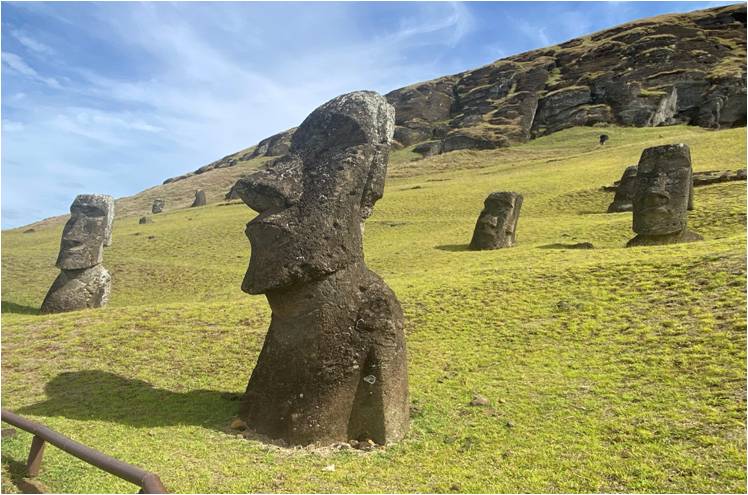
Rano Raraku quarry site (Author’s own photo)
The Moai main body was constructed out of grey hardened volcanic ash and the pukao or topknots pieces out of hardened red volcanic ash. A large moai could take 2 years to be carved by a team of workers under a master carver. (Grant-Peterkin, 2019).
There has been debate about how the completed pieces were moved to their standing platforms or ahu and there have been various suggestions and archaeological experiments discussing the use of wooden rollers, but it is now accepted that the moai were not dragged horizontally but moved vertically using ropes in a rocking motion like walking (Hunt & Lipo 2011). This fits the local oral history that says the Moai ‘walked to their resting places’ that they were imbued with a special spirit or mana.
The Moai were nearly always placed facing inwards to protect the islanders and represented the deified ancestors. (Fischer, 2005) They were not considered complete until their eyes made out of coral were added and this would be at the last stage as they were placed on the platforms or ahu. There is currently only one moai on its ahu that has eyes this is Ahu Tahai.
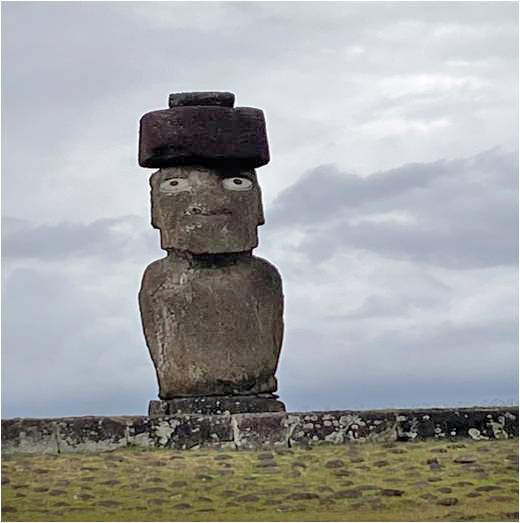
Ahu Tahai (Author’s own photo)
5
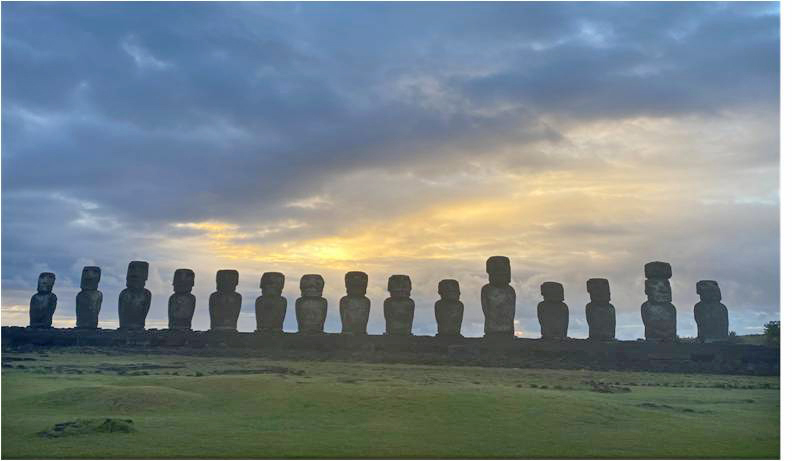
One of the best restored sites is Ahu Tongariki above (Author’s own photo)
Much later in the history of the settlement of the island there was internal conflict and war over the increasing population and territorial demands part of this conflict resulted in the toppling of the island’s moai. (Many are reconstructed into their upright position). In order to create peace, the Bird man competition linked to the fertility god Make-Make was inaugurated. This competition was carried out by a designated representatives of each of the seven tribes of the island; he was to climb down from the rocks into the sea and swim to the nearby island or motu where he would collect an egg from the returning migratory birds that were nesting. If he was the first to return with the unbroken egg his chief was to be the overall leader for a year. It was not without casualties. This site is called Rano Kau and is where the Orongo Ceremonial village is.
References
- Fischer, S.R. (2005) Island at the End of the World: The Turbulent History of Easter Island. London: Reaktion Books.
- Grant-Peterkin, J. (2019). A companion to Easter Island. Grafica LOM, Chile.
- Hunt, T.L. and Lipo, C.P. (2011) The Statues that Walked: Unraveling the Mystery of Easter Island. New York.
- Van Tilburg, J.A. (1994) Easter Island: Archaeology, Ecology and Culture. London: British Museum Press.
OTHER SOCIETIES’ EVENTS compiled by Eric Morgan
Please check with the organisations before setting out in case of any changes / cancellations and since since not all Societies or organisations have returned to pre-Covid conditions. Many organisations expect a small contribution from visitors.
Friday 9th January, 7.30 pm. Enfield Archaeological Society. Talk on Zoom. Spies, Lies and Amnesia: London’s Civil War Rewritten by Peter Mills. Please visit www.enfarchsoc.org.uk for further details and the link.
Monday 12th January, 3 pm. Barnet Museum and Local History Society. St. John the Baptist Church, Chipping Barnet, corner of High Street/2 Wood Street, Barnet EN5 4BW. Buried Voices: Stories of St Mary’s, Hendon. Talk by Reverend Dr. Julie Gittoes. Please visit www.barnetmuseum.co.uk for further details. Refreshments to be available after the talk. Visitors pay £2.
6
Thursday 22nd January, 7 pm. Hornsey Historical Society. Union Church Hall, Corner of Fermepark Road/Weston Park, London. N8 9PX. The Tower Gardens Estate: A Jewel in the heart of Tottenham. Talk by Ruth Crowley. Also on Zoom. Please visit www.hornseyhistorical.org.uk for further details and possible link.
Wednesday 28th January, 7.30 pm. Friern Barnet and District Local History Society. North Middlesex Golf Club, The Manor House, Friern Barnet Lane, London. N20 0NL. London Colney Airfield, Talk by Guy Thomas. Please visit www.friern-barnethistory.org.uk. Non-members pay £2. A drinks bar will be available.
Sunday 1st February, 10 am. Heath and Hampstead Society. Meet at the entrance to the Kenwood Walled Garden, opposite the Stable Block, off Hampstead Lane, London, NW3 7JR. Explore the Hidden History of the Heath with Michael Hammerson (Highgate Society Archaeologist). Guided walk lasts approximately 2 hours, Free. Further information from the organiser, Tereza Pultarova on 07776 649163 or email hhs.walks@gmail.com or please visit www.heathandhampstead.org.uk Turn up 5 – 10 minutes before start time.
Monday 9th February, 3 pm. Barnet Museum and Local History Society. St. John the Baptist Church (address as for Monday 12th January). On the Beat in Kings Cross. Talk by Chris Foster. Visitors pay £3.
Tuesday 10th February, 6 pm. L.A.M.A.S. Also on Zoom. A.G.M. and Presidential Address Given by Professor Vanessa Harding (Birkbeck, U.C.L.) on Mapping Restoration London. Please visit www.lamas.org.uk for the link.
Wednesday 11th February, 2.30 pm. Mill Hill Historical Society. Trinity Church, 110, The Broadway, London, NW7 3TB. The Hunting of Hephzibah (A Family History), Talk by Jim Nelhams (HADAS). Please visit www.millhill-hs.org.uk
Thursday 19th February, 8 pm. Historical Association: Hampstead and N.W. London Branch. Fellowship House, 136A, Willifield Way, London, NW11 6YD (off Finchley Road, Temple Fortune). 1983 – The World at the Brink of Nuclear Armageddon. Talk by Taylor Downing. Also on Zoom. Please email Dudley Miles (HADAS) on dudleyramiles@googlemail.com or telephone 07460 754075 for details of the link and how to pay (There may be a voluntary charge of £5). Refreshments to be available.
Friday 20th February, 7 pm. C.O.L.A.S. Also on Zoom. The Serpent Column, Istanbul, talk by Robin Densem (HADAS). Please book via Eventbrite. Visit www.colas.org.uk. HADAS may send out a link details to its members.
Friday 20th February, 7.30 pm. Wembley History Society. St. Andrew’s Church Hall (behind St. Andrew’s New Church), Church Lane, Kingsbury, London. NW9 8RZ. Journeys for the Brotherhood of Man! Talk by Jim Moher (Chair). Visitors pay £3. Refreshments to be available.
Wednesday 25th February, 7.30 pm. Friern Barnet and District Local History Society. North Middlesex Golf Club (Address as for Wednesday 28th January) Chicken Shed Theatre History. Talk by Adam Blackwell. Non-members pay £2.
Thursday 26th February, 7.30 pm. Finchley Society. Drawing Room, Avenue (Stephens’) House, 17, East End Road, London. N3 3QE. Postman’s Park/Watts Memorial –Uncovering historical secrets of London. Talk by Dr. John Price who will describe heroic stories of individuals in the 19th and 20th century London who have been memorialised in Postman’s Park, including a couple relatively close to Finchley. For further details please visit www.finchleysociety.org.uk Non-members pay £2. Refreshments to be available in the interval.
7
Saturday 28th February, 9.30 am – 5 pm. Current Archaeology Live 2026. U.C.L. Institute of Education, 20 Bedford Way (off Russell Square) London, WC1H 0AL held in partnership with U.C.L. Institute of Archaeology. Tickets now on sale and are available until 15th January from www.archaeology.co.uk/live at an early bird rate of £49 (after which the price increases to £65). Further details in next month’s Newsletter.
Exhibition London in WW2 extended to Thursday 19th February at the London Archives (as detailed in the September 2025 Newsletter).
Hendon and District Archaeological Society
Chair: Sandra Claggett, c/o Avenue House, 17 East End Road, Finchley N3 3QE email: chairman@hadas.org.uk
Hon. Secretary: Janet Mortimer 34 Cloister Road, Childs Hill, London NW2 2NP (07449 978121), email: secretary@hadas.org.uk
Hon. Treasurer: Roger Chapman, 50 Summerlee Ave, London N2 9QP (07855 304488), email: treasurer@hadas.org.uk
Website: www.hadas.org.uk
HADAS Festive Afternoon Tea Sunday 18th January 2026
If you have not already booked and would like to attend and meet up with other members.
Time: 2.30pm to 5.30pm. Place: Avenue House, 17 East End Road, N3 3QE. Cost: £20 per person
Includes: Finger Buffet (and tea/coffee) – Good company, Cash bar – Raffle – Quiz
Please contact Roger Chapman by the 2nd of January 2026 latest at treasurer@hadas.org.uk by email to see if there are places left (and how to pay).
________________________________________________________________________________________________________________
8