No. 659 February 2026 Edited by Andy Simpson
HADAS DIARY – Forthcoming Lectures and Events
Tuesday 10 February 2026 Dr James Bromwich ‘Great archaeological discoveries and great archaeologists of France’ POSTPONED DUE TO UNFORSEEN CIRCUMSTANCES
Speaker will now be
An old friend of HADAS – Robert Stephenson – LABYRINTHS WORLDWIDE & IN LONDON
The labyrinth pattern is thousands of years old and found in nearly every culture around the world. This talk examines their construction and the secret of their enduring fascination with examples from abroad, the UK and in London. It also demonstrates how to draw a labyrinth.
Tuesday 10 March 2026 Les Capon from AOC Archaeology will talk about ‘archaeological materiel evidence from Bricks to Gold’
Tuesday 14 April 2026 Scott Harrison on ‘Behind the Battle of Barnet banners; People of the War of the Roses. The lives of people that fought at the Battle of Barnet and the life, society and culture of the late fifteenth century’
Lectures held in the Drawing Room, Stephens House& Gardens, 17 East End Road, Finchley N3 3QE.7.45 for 8pm.Tea/Coffee/biscuits available for purchase after each talk.
Buses 13, 125, 143, 326, 382, and 460 pass close by, and it is a five-ten-minute walk from Finchley Central Station on the Barnet Branch of the Northern Line where the Super Loop SL10 express bus from North Finchley to Harrow also stops.
THE APRIL HADAS TRIP SUE LOVEDAY
If interested, do let HADAS Chair Sandra Claggett know (contact details on back page) as we are currently under the number needed for the trip to go ahead at the price quoted. We are investigating other options such as the impact on the cost for less people and/or possible deferment of the trip to later in the year.
LAST DAYS OF POMPEII JANET MORTIMER
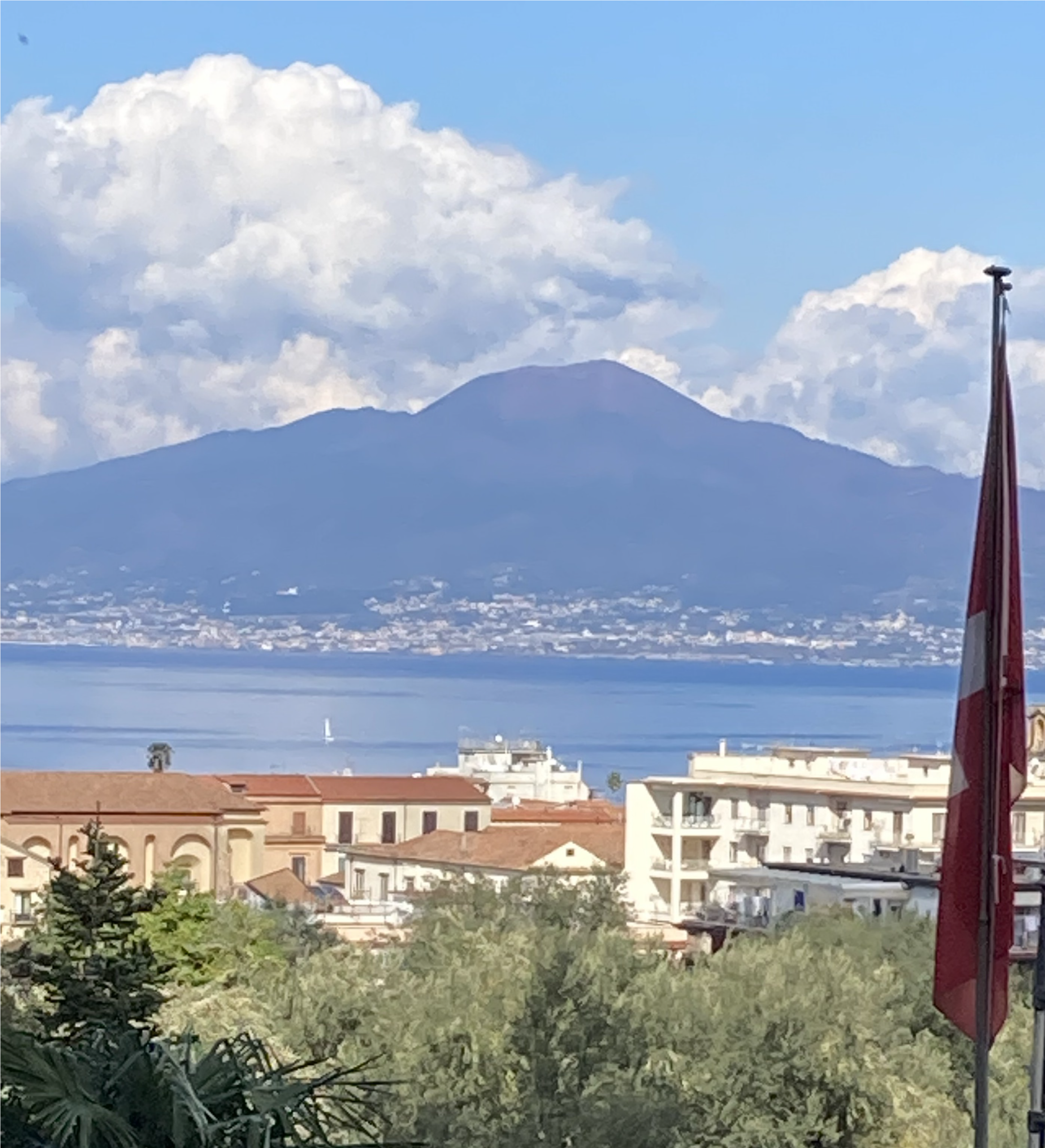
A few months ago myself and fellow HADAS member Barbara Thomas went on a tour in Italy where we were lucky enough to have a hotel room where we could sit on our balcony and gaze across the Bay of Naples, dominated by the magnificent Mount Vesuvius. On this tour we also visited both Pompeii and Herculaneum to see for ourselves the devastation caused by the eruption. So when we saw the Last Days of Pompeii immersive experience advertised at the Excel London, we were keen to go.
1
And what a fun experience it was. It started with exhibits and information on Pompeii and you proceeded through several different rooms all with different experiences.
One room told the story of life before and during the eruption, and in others you wore a headset to become part of the action with frightening reality. You are right in the centre of the arena with two fighting gladiators and you find yourself shrinking away from them as they almost brush past you.
When the volcano starts erupting and flaming boulders hurtle towards you, you actually dodge out of their way.
There is another room where you wander around with your headset on, becoming a disembodied statue’s head and hands, moving from room to room in a Roman villa where it shows you how rooms would have looked before and after the destruction. In reality you are just wandering around one room, where the staff are greatly amused by your actions as you try to touch things or avoid things that are not really there.
It really was a brilliant way to spend an hour or two and to experience what life must have been like then.
2
THE SANDERS LANE BRIDGE ANDY SIMPSON
Some readers will know of Sanders Lane NW7, which joins Bittacy Hill just north of Mill Hill East station on the Northern Line. Until August 2025 it crossed the disused tracked of the former Edgware, Highgate and London Railway, later successively Great Northern Railway/London North-Eastern Railway/British Railways operated line by a bridge constructed around 1880.
The line itself had received Parliamentary Authorisation in June 1862, and opened to Edgware on 22
August 1867, a month after the financially troubled original company was absorbed by the Great Northern Railway, forming one of the three ‘Northern Heights’ lines also serving Alexandra Palace and High Barnet on a low range of hills forming the Hampstead Ridge and the 430ft summit at High Barnet.
Steam- hauled passenger services shuttling the four mile, ten-minute journey between Finchley Church End (renamed Finchley Central 1 April 1940) via Mill Hill East and Mill Hill the Hale (Bunns Lane) to Edgware LNER ceased on 10 September 1939, replaced by buses, supposedly a temporary suspension to permit electrification and the planned and part-built extension beyond Edgware via Brockley Hill (where the part demolished uncompleted arches can still be seen) and Elstree (South) to Bushey Heath with anew depot at Aldenham (later used to assemble Halifax Bombers during WW2, and then as a London Transport bus overhaul works) as part of the 1935-40 New Works Programme.
The sleepy Edgware line was known locally as ‘The Pig’ for reasons lost in time, with 26 trains a day each way by 1938 on a ‘one engine in steam’ basis with limited signalling.
Work actually began at East Finchley in November 1936, and beyond Edgware in June 1939. This work was never completed, being suspended due to wartime conditions in November 1939, the section beyond Brockley Hill to Bushey Heath abandoned in October 1950 and eventually the whole extension was cancelled on 9th February1954.
Although double track with current rails had been laid as far as Mill Hill (The Hale) intended as an interchange with Mill Hill Broadway LMS station on the St Pancras – Bedford main line, the only part actually completed was the 0.9 mile-long single line branch from Finchley Central to Mill Hill East, opened mainly to serve Mill Hill’s Inglis Army infantry Barracks on Sunday 18th May 1941. Passenger services beyond to Edgware never resumed.
With closure initially proposed in October 1962, the last regular freight service to Edgware Goods, carrying mostly inwards bound coal and other bulk goods, which from December 1961 were all diesel hauled using 800hp Type 1 Bo-Bo locos, ran on 4th May 1964 with official closure from 1 June 1964.
Due to construction of the M1 motorway extension in the Mill Hill Broadway area the track beyond the current buffer stops at Mill Hill East was rapidly lifted for scrap, the last few yards beyond Sanders Lane bridge to Mill Hill East using a demolition train hauled by diesel D8235 on Saturday 19th September1964; the last BR train of all to Mill Hill East ran four days later to remove redundant materials. The land was gradually auctioned off.
A dwindling need for BR locos on Underground stock transfers to Highgate Sidings south of East Finchley saw the last BR train leave Highgate Sidings for Drayton Park via Crouch End on Sunday 4thOctober 1964. Since then only London Underground stock has run on these lines, although the three miles of former BR track from Highgate to Drayton Park was last used on 29th September 1970 and was lifted in January 1972.
3
In recent years the bridge has become badly cracked with areas of brickwork falling away, making it unsafe for further use. It was closed to road vehicles in 1993 and to pedestrians in March 2023.
In the 1960s B/W view on the following page, the current Mill Hill East terminus is behind the photographer; on the left is the site of part of the former Mill Hill East North Goods Yard, extended around 1942 to accommodate wartime army traffic, but closed 1 October 1962 along with the BR goods yards on the Barnet branch of the Northern Line.
These sidings had included a private siding serving the former Mill Hill East gasworks, opened in 1886, which under later North Thames Gas Board auspices ceased gas manufacture – and hence the need for coal trains, invariably hauled by LNER Gresley 0-6-2 tank engines which handled all freight on the Edgware and High Barnet lines – in November 1961.
By 1956 four coal trains a day were needed to serve the gasworks plus two daily goods trains to Edgware. In 1960 the gasworks received some 68,000 tons, mostly coking coal for coal gas manufacture at the gasworks, in 5,640 wagons – a significant loss of traffic.
Despite rules on number of wagons on tube lines, on a Monday morning trains of over 60 empties frequently came out of Mill Hill Gas Yard, since the Saturday and Sunday trains always returned to King’s Cross light engine, leaving their loads to be emptied over the weekend. They ran via East Finchley at 40mph or more. All those clanking and banging coal wagons must have been a sight (and sound) to behold…
In the opposite direction, the rules permitted one train down the single line to Mill Hill at any one time, so the Edgware goods train could be followed by a gasworks train and then one for Mill Hill Military Yard.
Each train was protected by a ground frame controlling the points that was locked by a passenger train being in the platform at Mill Hill, so the signalman could let all three goods trains out, one at a time.
After the gas works coal trains ceased, there was a reduced freight service on the Edgware branch as of 6th November 1961 with just one train to High Barnet and one to Edgware daily. A regular morning freight worked to Edgware via Finchley Central and Mill Hill East throughout 1963, becoming an ‘as required’ service in 1964 until final closure.
Just to confuse matters, Edgware was part of the London Midland Region, served by Eastern Region trains running over tracks maintained by London Transport!
Steep gradients of up to 1 in 59/60 meant trains were normally limited to 14 loaded wagons worked at 20 mph over LT tracks.
The Edgware branch averaged 12 loaded wagons a day outward to Clarence Yard, Finsbury Park. There was a rule that no more than 19 wagons, including the brake van, were to work over the tube lines.
4
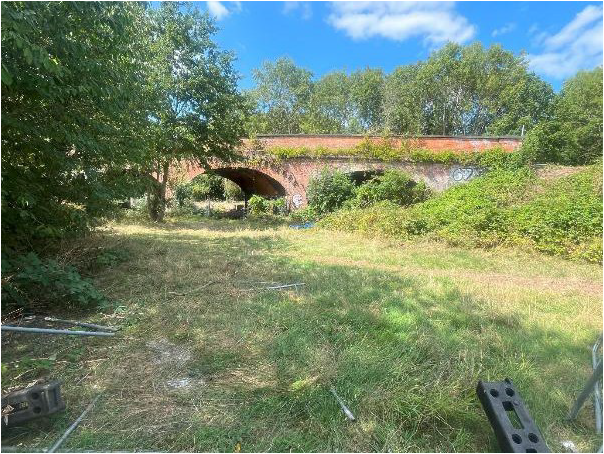
Sanders Lane bridge in the mid- 1960s, not long after track lifting looking towards Edgware;
Original photographer unknown; Author’s Collection.

(next page) View from similar angle just prior to demolition, August 2025.
The area behind the photographer is now occupied by two blocks of 1960/70s houses, recently extended, with the grassed area as their communal garden. They would have been in the way of a proposed late1980s re-extension of the line as a single track around 1.3km to serve a basic station and probable shuttle service to serve Copthall Stadium and golf course and the surrounding parkland.
The original 1930s scheme had also considered a station in that vicinity. Barnet Council wanted to improve access to the stadium, but they were somewhat startled when London Underground announced that it was investigating the proposal on 16 July 1990; it would also serve the housing planned for the 22-acre Inglis Barracks site. It was anticipated that if the million pound plus funding could be found it would open by 1997. The scheme was halted on cost grounds but discussed again in 1992, but the cost-benefit analysis did not support the plan, and it does not seem to have been mentioned since.
A decade or so later The Brent Cross Coalition, in advance of the construction of Brent Cross New Town, proposed a similar route extension, to be built as a light railway extended beyond Copthall past the RAF Museum via Grahame Park Way to Colindale and Kingsbury Road to Hendon National Rail station. Again, nothing came of this proposal.
The recent housing extensions and blocking of the track bed by the new pedestrian/cycleway causeway now blocking the track bed where the bridge used to stand would seem to mitigate against any further such proposals.
5
The HADAS connection
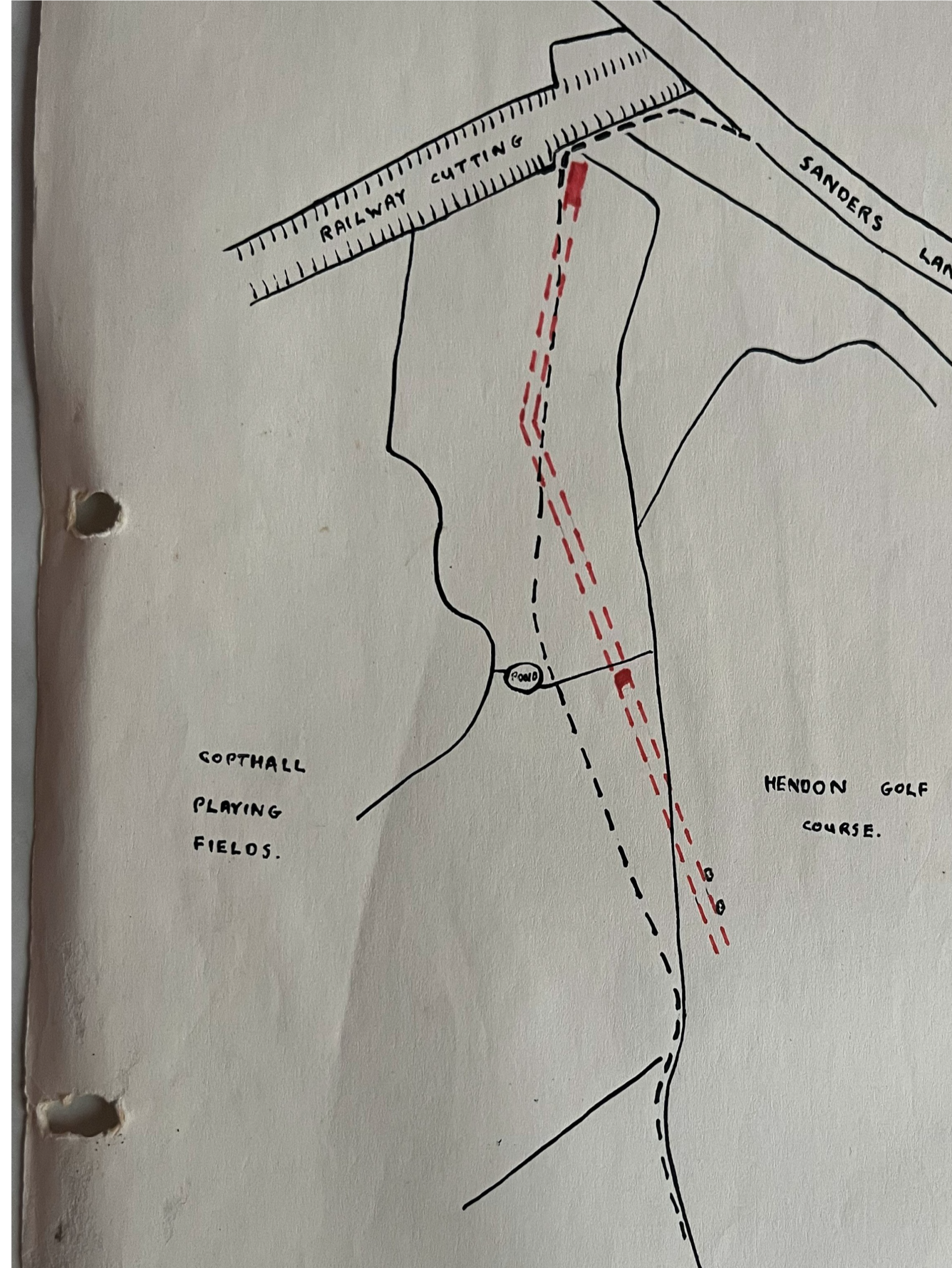
Interestingly, HADAS excavated close to the Sanders Lane bridge between 27 July and 28th August 1967, Site B, at OS ref. TQ 23239139, SMR ref 081961 and 081877. Directed by Brian Robertson, HADAS dug in the south bank of the disused railway cutting of the former line to Edgware, at a point where a stile adjacent to a public footpath had formerly permitted pedestrians to cross the track.
This was during investigations into the line of a postulated late Roman Road from Verulamium to Londinium via Mill Hill, known as Viatores route 167 from the 1960s research group who suggested it.
As reported by Robertson, Site B comprised both the south bank of the railway cutting and the relevant portion, of Copthall Fields (Areas 1 and 2) which were included in one grid based on the Sanders Lane road bridge over the railway at TQ 232914. The base line of the grid was laid along the track bed from a point 14 ft. along a line joining the west face of the two supporting piers. This point was at a perpendicular distance of 11 ft. 1in. from the brickwork of the northern pier. The north-west corner of the grid was located 240 ft. from this point and a grid of 10 ft. squares was laid.
Following a resistivity survey HADAS found not this road but another one, relatively short-lived and of mid-late first century date from the 120 or so sherds of mostly greyware pottery (some of native Celtic British style, and others similar to pottery from the Highgate kilns) found in or near the roadside ditches,21 feet wide with a packed pebble and cobble surface, running north-south.
The Society corresponded with a Mr. Morris, the Clerk of Works of the Estates and Surveying Department of the London Midland Region of British Rail as the cutting was still BR property at the time just three years after track lifting, and he visited the site and approved the proposed works.
6
It was reported in Helen Gordon’s paper ‘A Roman Presence in the Borough of Barnet’ HADAS NL 102,10-11 (1979) and AN INVESTIGATION OF ROMAN ROAD No. 1671 BY BRIAN ROBERTSON (Hendon and District Archaeological Society) TLAMAS 22 pt 3 1
The original site archive folder, including the excavation diary and exhibition captions, is held by HADAS. Herewith the original site plan;
7
Further view taken August 2025
Note the unused London Transport iron cable brackets for the intended 1930s ‘New Works Programme’ Northern Line electrification to Edgware over the central arch; the track to Edgware would have been doubled and much of the line side cabling structure as far as Edgware was in place by 1940.
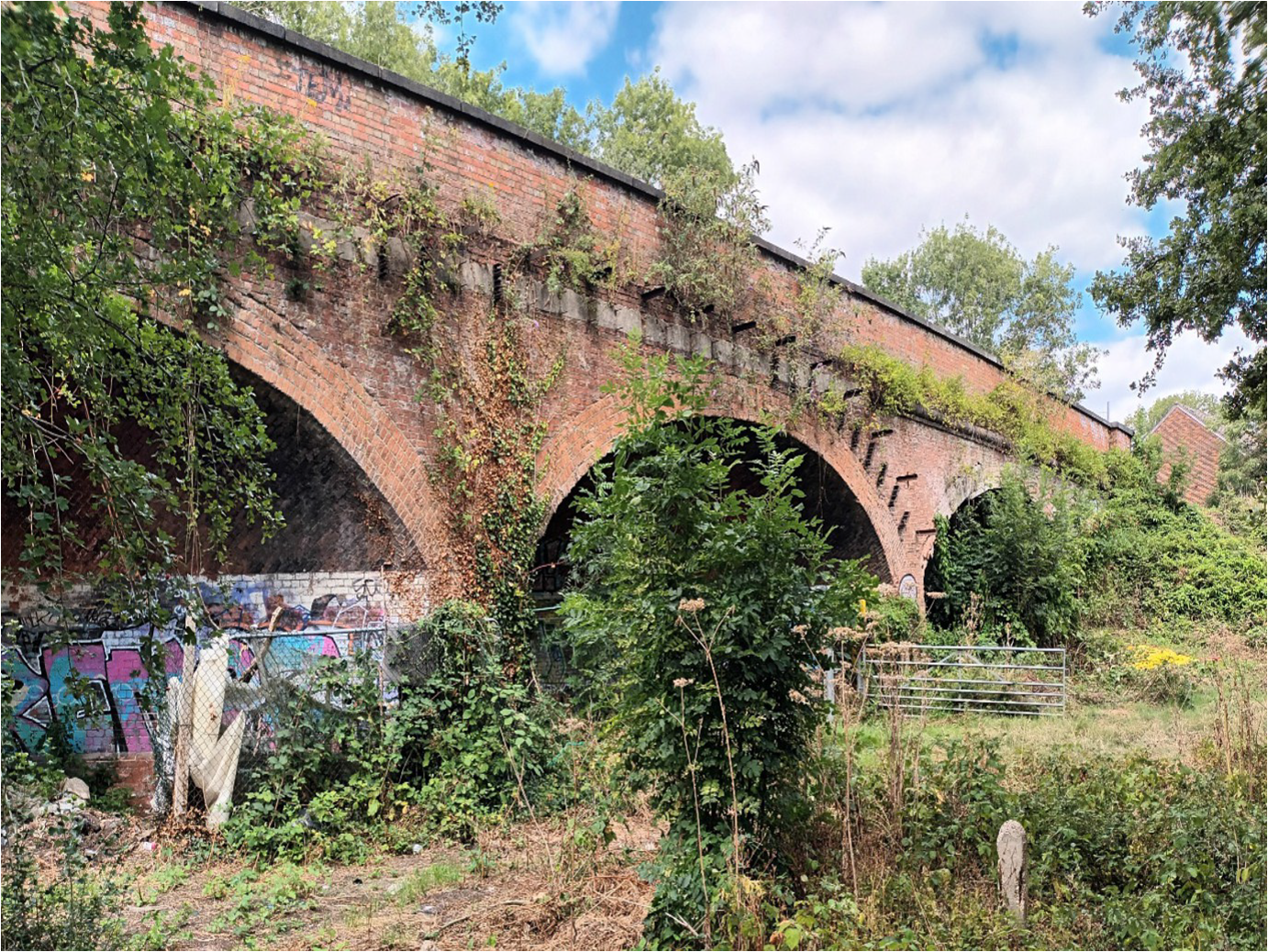
The bridge immediately after demolition earlier that day, 20th August 2025; the work of two JCBs.
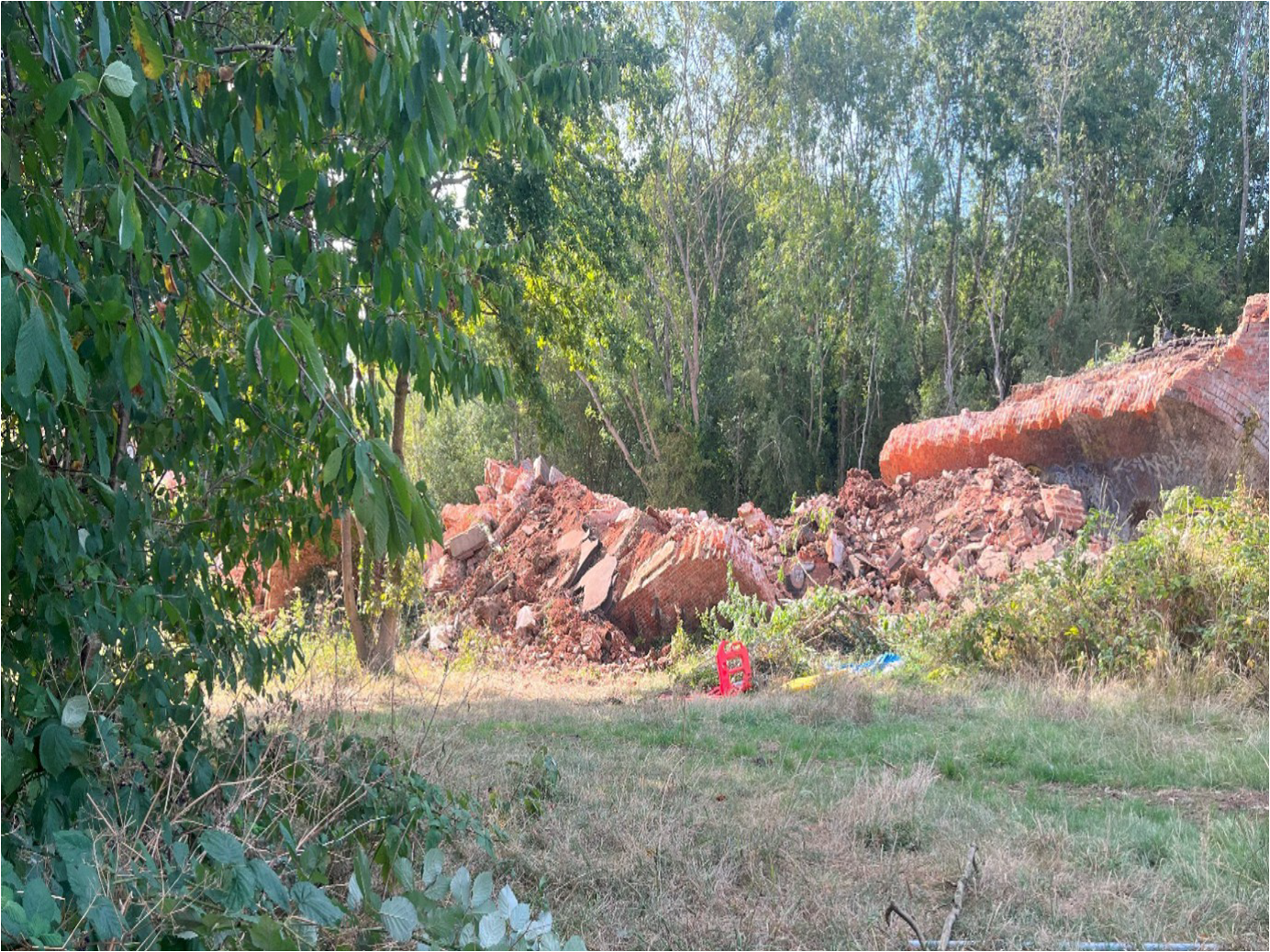
For details of the Barnet Council Sanders Lane project, including construction of a replacement footpath, seemingly using crushed brickwork from the former bridge as a foundation, see
Sanders Lane Bridge works | Barnet Council Landscaping work ongoing when site visited 18 January.
8
Bibliography
The First Railway to Edgware Opened 22 August 1867 (Church Farm House Museum Exhibition guide) London Borough of Barnet 1967
Underground Number 9 The Northern Line Extensions Edited by David Hayward The London Underground Railway Society 1981
The Hampstead Tube A History of the First 100 Years A. Badsey-Ellis Capital Transport 2007
The Northern Line Extensions Brian Hardy & MRFS Supplement to Underground News No. 599 November 2011 London Underground Railway Society
Plus various issues of Railway Magazine from 1919 to 1973, Railway World, Railway Observer and London Railway Record.
Membership Matters
Members are kindly reminded that the HADAS membership year runs to 31st March, so renewals are due in April.
We are also in need of a membership secretary – contact our secretary Janet Mortimer if you are willing to stand for the post. And from the next AGM we will be looking for a Treasurer.
SUNDAY MORNING POST EXCAVATION WORK continues on the material from our 2025 Vine Cottage Hendon dig. All finds are now washed and sorted with the Bulk Finds Sheets completed, ‘Small Finds’ picked out and listed and virtually all the individual finds type record sheets have been filled out, with thoughts now turning to specialist reports on various categories of finds. There is certainly a smattering of seventeenth/eighteenth-century material amongst them.
RETURN TO CLITTER HOUSE ANDY SIMPSON
On Sunday 7 December 2025 several HADAS members attended a small informal event at Clitterhouse Farm in Claremont Road NW2, near the Brent Cross shopping Centre, site of HADAS excavations in 2015, 2016 and 2019.
This was at the invitation of Jenny Lawry from the volunteer group, hosted by the Our Yard Clitterhouse Farm social enterprise team (www.ouryard.org), who wished to mark the 2026 centenary of the adjacent extensive Clitterhouse playing fields established by Hendon Urban District Council on the Eastern/North Eastern fields of the farm after the last of the farm’s dairy cow livestock and equipment was auctioned off in 1925. The volunteers – The Clitterhouse Secret River Sweepers (SRS) – clear the Clitterhouse brook of accumulated rubbish and monitor its condition through citizen science techniques on the first Sunday of every month. They meet in the café built exactly on the site of the HADAS 2019 excavation.
The HADAS team took along a display produced by the Sunday morning team made up of Clitterhouse maps, plans, photos and finds, plus HADAS publications and souvenirs, which were much appreciated by the small but engaged group of volunteers and visitors of all ages. The coffee and cake kindly provided went down well too!
9

Above; The HADAS display. Below – Janet and Bill gave short but informative presentations to
visitors. More photos on the HADAS facebook page…

BILL BASS adds …
10
As well as our work on immediate environs of Clitterhouse Farm we also spoke on the survey and evaluation undertaken on the Clitterhouse Playing Fields in conjunction with the possible redevelopment of the sports surfaces and such like. In 2015 a large ranging geophysical survey was done by Cranfield University led by Peter Masters, HADAS worked with Peter a year or so ago when surveying Old Fold Golf Course and in Kew Gardens Archive in connection with alternative theories on the Battle of Barnet. The Clitterhouse survey revealed a number of features and targets including possible a medieval farming practice called ‘ridge and furrow’. These features could be tested by a field-evaluation and in 2021/2022Museum of London Archaeology undertook a project of 72 trenches placed over the fields and likely targets.
The evaluation found Roman pottery, brick and tile as well as environmental evidence in association with Roman field boundary ditches. This provided a useful context as Watling Street Roman-road (now the Edgware Road) runs not far west of the site. Also found were many Victorian glass bottles. Some of the known buried air-raid shelters surrounding the fields were investigated.

Mola archaeologist Giulia Rossi and some of the Roman pot found on site. (Photo: Mola website).
Other Societies’ Events Eric Morgan
As always, please check with the societies – for example via their websites – before planning to attend in case of any late changes, since not all societies and organisations have returned to pre-covid conditions.
Friday 13th February, 7.30 pm. Enfield Archaeological Society. Jubilee Hall, 2, Parsonage Lane/Junction Chase Side, Enfield, EN2 0AJ. Roman Cemetery at Holborn Viaduct. Talk by Alex Banks. Please visit www.enfarchsoc.org.uk for further details. Visitors charge £1.50. Refreshments, sales and information from 7 pm.
Wednesday 18th February, 7.30 pm. Willesden Local History Society, St Mary’s Church Hall, bottom ofNeasden Lane (Round corner from Magistrates’ Court) London, NW10 2DZ. The Grodzinsky Family. Talk by Jonathan Grodzinsky (4th Generation Master Baker). Will talk about the history of his family and the Grodzinsky Bakery in Willesden Green. Grodzinsky’s Bakery firm had late C19th roots in the East End of London and went on to become the largest Kosher Bakers in Europe. Please visit www.willesden-local-history.co.uk for further details.
11
Monday 9th March, 3 pm. Barnet Museum and Local History Society. St. John the Baptist Church,Chipping Barnet, Corner High Street/2, Wood Street, Barnet, EN5 4BW. Remembering Bungo: The life and Career of Field Marshall Lord Byng of Vimy. Talk by William Frank. Please visit www.barnetmuseum.co.uk for further details. Refreshments available afterwards. Visitors £3.
Wednesday 11th March, 2.30 pm. Mill Hill Historical Society. Trinity Church, 100, The Broadway, London. NW7 3TB. Farms and Farming in Mill Hill. Talk by Michael Worms. Please visit www.millhill-hs.org.uk. Preceded by A.G.M.
Friday 13th March, 7.30 pm. Enfield Archaeological Society. Jubilee Hall (Address as for Friday 13thFebruary). A.G.M. followed by Review of 2025 Excavations and Further Plans. By Martin Dearne (Director of Archaeology).
Thursday 19th March, 8 pm. Historical Association: Hampstead and N.W. London Branch. Fellowship House, 136A, Willifield Way, London, NW11 6YD (off Finchley Road, Temple Fortune).P.G. Wodehouse and the Decline of the British Empire. Talk by Dr. Sean Lang. Also on Zoom. Please email Dudley Miles (HADAS) on dudleyramiles@googlemail.com or telephone 07469 754075 for details of link and how to pay (there may be a voluntary charge of £5). Refreshments available.
Friday 20th March, 7.30 pm Wembley History Society, St Andrew’s Church Hall (Behind St. Andrew’s New Church) Church Lane, Kingsbury, London, NW9 8RZ. The Early History of the Grand Junction Waterworks. Talk by Bob Casey. Visitors charge £3. Refreshments available.
Wednesday 25th March, 7.30 pm. Friern Barnet and District Local History Society. North Middlesex Golf Club, The Manor House, Friern Barnet Lane, N20 0NL London Underground Architecture. Talk by Mark Andrew Pardoe. Please visit www.friern-barnethistory.org.uk. Non-members. £2 Bar to be available.
Thursday 26th March, 7.30 pm. Finchley Society. Drawing Room. Avenue (Stephens’) House, 17, East End Road, London. N3 3QE. Alexandra Palace Theatre. Talk by Pat Brearey and Nigel Willmot. (Friends of Alexandra Palace Theatre). For further details please visit www.finchleysociety.org.uk. Non-members. £2. Refreshments in the interval.
With thanks to this month’s contributors; Bill Bass; Sue Loveday; Janet Mortimer; Eric Morgan
Hendon and District Archaeological Society
Chair Sandra Claggett, c/o Avenue House, 17 East End Road, Finchley N3 3QE
email : chairman@hadas.org.uk
Hon. Secretary Janet Mortimer 34 Cloister Road, Childs Hill, London NW2 2NP
(07449 978121), email: secretary@hadas.org.uk
Hon. Treasurer Roger Chapman, 50 Summerlee Ave, London N2 9QP (07855 304488)
email: treasurer@hadas.org.uk
Membership Sec. Vacant; membership@hadas.org.uk
Website: www.hadas.org.uk – join the HADAS email discussion group via the website.
12